Pendlev2 maturity
At the end of a Pendle V2 market's term, its Principal Token (PT) becomes redeemable and its Yield Token (YT) stops earning new yield, with its token value reaching zero. PT normally redeems for an amount worth one unit of the market's accounting asset per token, but redemption can be lower when an interest-bearing asset's exchange rate is below its watermark.
The relevant expiry belongs to the selected market. The same yield-bearing asset can have separate markets with different maturity dates.
What PT pays at maturity
The accounting asset appears in brackets at the end of the PT market name. It determines the unit in which the principal claim is measured. For an interest-bearing token, redemption can deliver an amount of the underlying yield-bearing token worth that accounting-asset claim. The number of tokens received therefore need not equal the number of PT redeemed.
The difference between the acquisition cost and redemption proceeds determines the return from holding PT through expiry. PT holders forgo the underlying variable yield and points allocated to YT.
The negative-yield exception
The watermark rate is the highest recorded exchange rate between an interest-bearing token and its accounting asset. When the exchange rate is below that watermark, PT can redeem for less than its normal accounting-asset amount at maturity. YT yield accrual pauses until the exchange rate recovers to the watermark and ends permanently at maturity.
Pendle's Watermark Rate view shows the current exchange rate alongside the watermark.
Selling before expiry or redeeming afterwards
Before maturity, PT and YT can be sold at market prices, subject to available liquidity. An early PT sale can return a different amount from holding the position to redemption. Trades can also be constrained when they would push a pool beyond its configured yield range.
After the selected PT market has matured, redemption is available through the Pendle Dashboard. Select the matured position and an output asset. Once the redemption transaction succeeds, you receive the selected output asset, with a swap if needed.
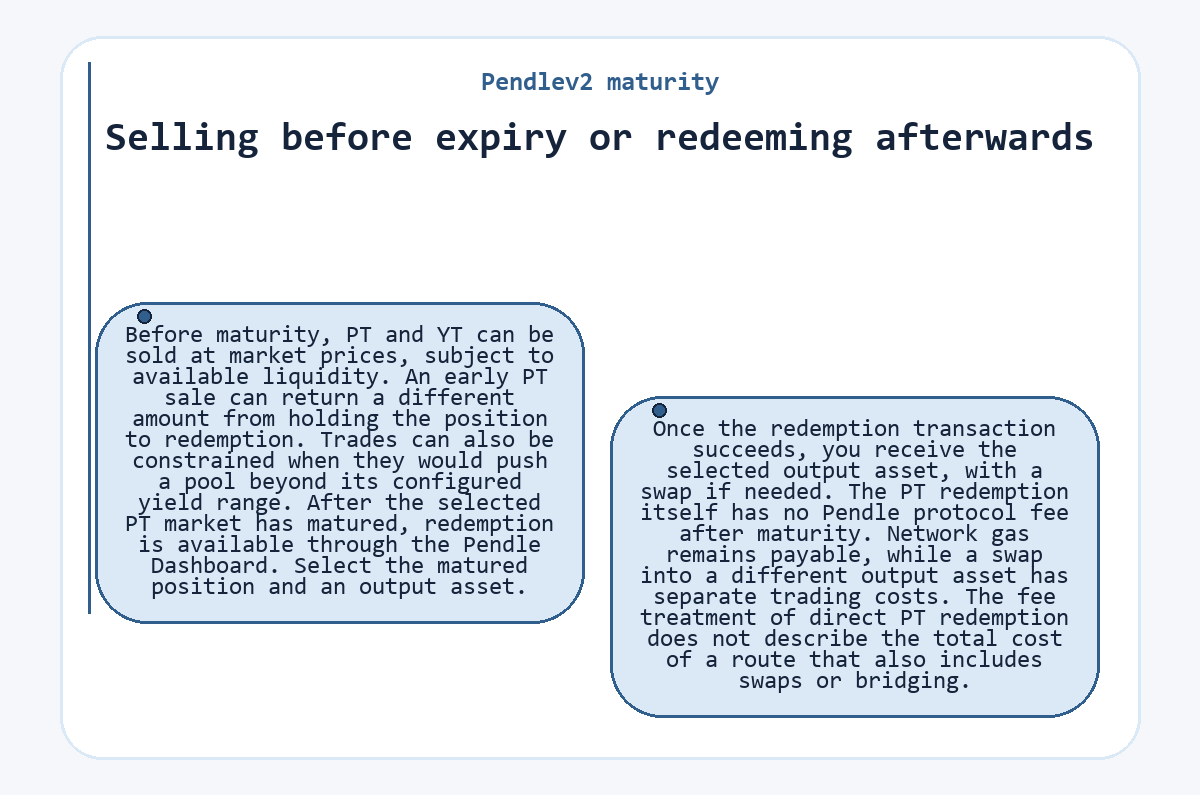
The PT redemption itself has no Pendle protocol fee after maturity. Network gas remains payable, while a swap into a different output asset has separate trading costs. The fee treatment of direct PT redemption does not describe the total cost of a route that also includes swaps or bridging.
YT expiry and pending yield claims
For continuously accruing markets, maturity ends new YT yield without cancelling yield already accrued. Earned yield can be claimed through the Pendle Dashboard, including before maturity. YT yield is distributed as Standardized Yield (SY), the wrapper for the underlying yield-bearing asset, and can be unwrapped into that asset. Expired YT has no principal redemption claim.
Discrete-yield markets distribute periodic yield retrospectively under separate eligibility rules. For each YT or liquidity provider (LP) position, the eligible SY exposure is the smaller of its time-weighted average SY exposure during the distribution period and its SY-denominated balance at the payout block. YT and LP positions are calculated separately.
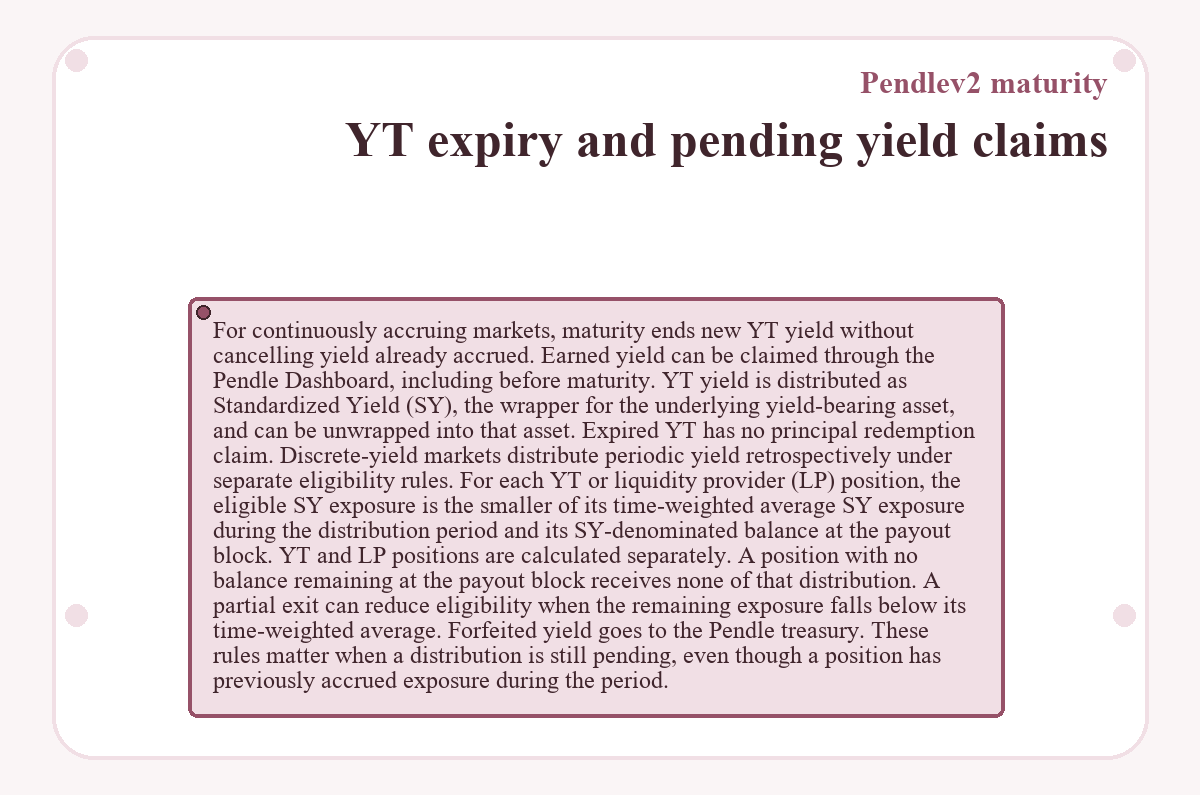
A position with no balance remaining at the payout block receives none of that distribution. A partial exit can reduce eligibility when the remaining exposure falls below its time-weighted average. Forfeited yield goes to the Pendle treasury. These rules matter when a distribution is still pending, even though a position has previously accrued exposure during the period.
Unredeemed PT and expired liquidity positions
The assets backing matured, unredeemed PT or LP positions can remain in SY and continue generating yield and points. All yield and points generated by those positions after maturity are redirected to the Pendle treasury fee wallet. Keeping an expired position does not extend its former yield entitlement.
For an expired liquidity pool, Pendle's Inactive pool list provides a combined exit that removes liquidity, redeems the PT portion, unwraps SY and performs any needed output swap. Enabling Claim All Pool Rewards includes accrued pool rewards in that transaction. Pending discrete-yield distributions remain subject to their own eligibility rules.
Redeeming PT held on another chain
For a supported cross-chain PT position, the Dashboard can bridge matured PT back to its original market chain and redeem it in one flow. The route and estimated fees are shown before confirmation. Holding PT on another chain does not change the maturity of its underlying market.
If the first step fails before funds move, those funds remain in the wallet. A failure after funds have moved can offer Accept and Retry at updated rates or Refund. The refund returns the token at the last successfully completed step, which may be an intermediate token on the source chain. When retrying is unavailable, such as when no suitable route exists or the PT market is no longer available, only Refund is offered.
Maturity decision checklist
- Use the expiry attached to the selected position's market.
- Confirm the accounting asset and, for an interest-bearing market, compare the exchange rate with its watermark.
- Distinguish an early sale quote from matured PT redemption, including any swap, gas and bridge costs.
- Check pending discrete-yield eligibility before selling YT or removing liquidity.
- After a cross-chain failure, identify the token and chain available through the displayed retry or refund option.